Tuesday, 7 May 2013

Monday, 29 April 2013
Veronica - Characterisation
Veronica is the only main character included in our film opening. We purposely did this so we could concentrate the audiences attention on her character and put them in her perspective, emitting a feeling of the isolation and abandonment. We introduce Veronica with sad non-diagetic music, which helps portray how she is feeling. Moreover we replicate this 'sad' portrayal in our mise en scene; dark, eerie and urban scenery. We also added diagetic sirens to lead the viewer to believe she was in a dangerous place, this highlights her vulnerability. We then pivoted the camera around Veronica to give a close-up of her face, which shows her sighing. Due to this the audience may begin to sympathise with her. As well as this, during the close-up there's a blurring editing effect (done by Bruno) to reflect Veronica's confusion.
(The dim, dark and eerie mise en scene)

(The blurring effect)

Sunday, 28 April 2013
Film Proposal - Land of the Free

Out of the members of our group, Bruno elected himself to write the film proposal, here it is....
Film Proposal
Veronica is a young teenage girl from a refugee family living in Chicago, USA. She been abandoned by her family at the age of 13, the state do nothing to help her and she spent alot of her life all alone and isolated. Unable to work or find a job as she was too young, Veronica turned to prostitution to survive until she was 15 until where one of her clients kidnapped her and brought her to his boss, Rodney. Rodney is a london born and bred crimelord who came to America to get away from people who wanted to escape from his enemys, and begin a new crime syndicate based on mass import and export of drugs and prostitution. Veronica was taken to Rodney and was offered protection and a place to stay in return for being pimped out by Rodney. Due to Veronicas desperation she accepted. Veronica spent two years under the thumb of Rodneys criminal organisation, having no one to turn to and nowhere to go she was virtually alone. Over the two years her anger and resentment grew towards Rodneys organisation for what they had done to her. She discovered where the money from rodneys criminal misdemeanours was kept before it was laundered. She had always managed to take a couple of notes when they werent fully focused on the duffle bag filled with money. Her emotions got the better of her and she struck out at the men watching the bag, grabbed it and made a run for it narrowly escaping by jumping out of a second story window. Thanks to this she essentially painted a bullseye on her head and subsequently Rodney sent his hired 'Goons' to go after her, kill her and get the money back. Veronica hidden her money in a place of great emotional sentiment to her as she knew it would be safer there than carrying it around with her. Veronica begins to spend her money on alcohol and drug fuelled night when she has a sad moment of clarity on a comedown from her Methodrone high at the end of the weekend. She realised how alone she was and how empty her life is. She realised she now had the means to make something of herself and do something valuable. She spent the remaining money she had on her on various bus tickets to get her to Los Angeles in California. In the early hours of the morning she made a dash to get the duffle bag of cash and to begin her new life. When in California she met a social worker who was the first person she opened upto for the first time in her life and who she begged for to help. She was directed to some people who ran a charity called 'Children of the night' which helped child prostitutes be taken away from that lifestyle and dominating pimps. After having been helped by the charity, Veronica realised that the money she had stolen would be better put to use donated to the charity. The Charity was so grateful for the donation they wrote an article about her on their website http://www.childrenofthenight.org/index.html, It was through this became getting famous on national television, telling her story to the millions who watched and being a source of inspiration by the fact that she overcame her hardship. One night when Veronica was coming back from a fundraising event to her apartment. She hear the click of a pistol being cocked directly behind her head, and she died that night.
Length of film:
We want to keep it to be a shortish film as we want to have a sense of constant intensity through out the film without having any scenes which are unnecessarily elongated, and also due to the fact that we are a small and independent production company we simply do not have the budget to afford the extra time of camera equipment rentals and actors wages.
Budget:
We are working with a relatively low budget of £300,000 due to the fact we are a small production company but also because the style of movie we are using is relatively inexpensive to make as it is done mainly with handheld cameras in urban environments to give the narrative a sense of gritty realism like you are right there with the main actor Veronica throughout her journey. We will apply to Film4 commissioning department to look for funding as they tend to try and support upcoming British directors and production companies.
Genre:
The genre of our film is a gritty drama which encompasses characteristics and narrative conventions of other films and genres. The text of our film will fulfil some generic expectations of the genre, for example life or death situations, urban scenery, portrayal of a journey of a character development and the dramatic storyline that is supposed to move the audience emotionally.
Target Audience:
We are aiming to target young adults, as there will be aspects of the youth subculture, but the narrative of the film makes it accessible to people of all ages and social classes.
Our film will most likely be rated and 18 by the British Board of Film Classification. This is due to the fact our film contains alot of senstive topic, themes and graphic scenes. Our film contains: Discriminatory language and behaviour, Very strong violence, frequent strong language, strong portrayal of sexual activity, discriminatory and offensive themes.
Veronica (The Protagonist)
Main characters:

Veronica: A teenage girl who has had a tough upbringing which began with her family fleeing from Poland due to political tensions in her neighbourhood of 'Ursynow' between her father who was head of the local communist party, and the local Neo-Nazi political group who chronically vandalised her family home, they finally fled when her house was petrol bombed and her father was brutally beaten. After this her family fled to Miami in America as they had family living and working there. As Veronica entered her teenage years she began to experiment with drugs and alcohol, once her parents discovered she had developed an addiction to Methodrone, Her family spent their life savings sending her to a top treatment clinic in Chicago, which she escaped from in a desperate state to score some more Methadrone. She from then on severed connections with her family and spent the last few years of her life alone and fending for herself by living in abandoned houses and industrial estates, being left no other option to make money Veronica reluctantly turned to prostitution as her only means to fund her addiction.
iLL Manors was a huge inspiration in the construction of the character of Veronica, The story of a teenager getting an addiction to Hardcore drugs and becoming destitute is not an uncommon one, which we felt was well portrayed in iLL Manors as the character Michelle was portrayed as a stereotypical drugs addict in the form of most of her behaviour (eg, prostitution, petty burglary, etc) but also shows a different side to her which is unexpected and widens our views on her due to breaking the typical behavioural conventions of a drug addict. Below is a short clip of the actor who plays Michelle explaining the fundamental factors of her
 Rodney (Crime Lord): The leader of the crime syndicate that has main control of the criminal underworld of Chicago. He was born and raised in the East-end of London where he became a notorious drug kingpin who was responsible for most of all the cocaine, cannabis and firearms in London. He is third generation Ghanaian and he started his criminal life when his uncle used to send him on little 'jobs' around his area (delivering pay as you go phones to his uncles contacts). As Rodney grew up he started taking bigger jobs and climbing up the criminal hierarchy until his uncle was kidnapped from his home by a rival gang and executed. Rodney then started taking over his uncles position when he reached twenty five and became the notorious man to fear by the time he was twenty eight. He expanded the business from drugs to firearms which he was arranging to be brought in from the west indies and Latin America, but while inspecting a shipment of automatic weapons from Peru a rival gang stormed his warehouse headquarters and killed most of his men and left Rodney with bullet wounds to the leg, arm and a punctured lung. The rival gang soon took over his business killing all Rodney's associates, and putting a price on his head. Being too dangerous to stay in London he fled to the United States and settled on Chicago as he had associates who were controlling the synthetic drugs trade in from the Canada to the north of the United States. He started recruiting within the Chicago crime syndicate and he and his new crew executed the Bosses much like the rival gang had back in London and took control of the operation. He started to branch out into pimping prostitutes to bring in more money and expand his drugs market. He has remained anonymous by bribing Political figures within the Chicago sector of the government, police officials, DEA agents and executives who control the press. He is rarely seen by anyone except his second in command, he never directly handles anything in his business unless absolutely necessary to prevent what happened in London happening again. He has built a small army of hired thugs, who wear the black suit and with no tie as an inconspicuous uniform to make his presence know in the criminal underworld.
The film iLL Manors shares many of the same narrative characteristics and the character 'Kirby' has also had a great influence on the construction of the character Rodney. They share a lot of the same personality characteristics and desires.
Monday, 15 April 2013
Applying the concept of Genre to our film
After much consultation with my group, we decided we would make the genre of our film, 'Gritty Drama'. This entails a number of different topics such as isolation, crime, abandonment, violence and sexual abuse etc. As a result of this, our film will raise much empathy and concern among the audience due to Veronica's compelling story. Furthermore, we wanted realism to be a huge aspect of our film, as we wanted to depict some parts of our society accurately. This is so we could embed a social message within our film, which eludes to the fact that many people are forgotten and abandoned in our society.
In our film opening we tried to include much of the above (topics) as possible. The text includes a dim and urban setting with life and death situations and compelling characterisation. We also included a chase which would fulfil much of our criteria (abuse, violence, crime, isolation etc.) and raise nerves, tension and engagement in the audience. As I have already stated, the mise en scene is dark, eerie and dim scenery which will help to reflect Veronica's emotions and gage sympathy from the spectator. To include an aspect of crime in our piece, when editing we added in sirens (diagetic).
'Land of the Free' incorporates a handful of different genres including the obvious ones such as 'crime and gangster', 'drama' and 'horror'. However, in order to get a greater understanding of our own genre we must look at the less known genres. Our film does not have a happy ending; thus includes aspects of the genre 'a slice of life', a genre which depicts events of everyday life (hence the inclusion of the word 'life'). As a result of this, our film could be compared to the French film 'Cache' (Hidden) which has the most sudden and anti-climactic endings I have ever seen. Nevertheless it is a great film and could be seen as symbolic, as it's sudden and un-conventional ending, reflects the reality of life. Our film could also fall under the biographical genre, as it gives great detail of one persons life. The two above genres are reinforced by the fact we used a handheld camera, an everyday camera used by the masses (nothing special).
As you can see we have developed and integrated genres whilst keeping some level familiarity. This is too ensure we have met the audiences expectations yet included some originality also. We believe that our film is a modern adaption and incorporation of a handful of genres.
In our film opening we tried to include much of the above (topics) as possible. The text includes a dim and urban setting with life and death situations and compelling characterisation. We also included a chase which would fulfil much of our criteria (abuse, violence, crime, isolation etc.) and raise nerves, tension and engagement in the audience. As I have already stated, the mise en scene is dark, eerie and dim scenery which will help to reflect Veronica's emotions and gage sympathy from the spectator. To include an aspect of crime in our piece, when editing we added in sirens (diagetic).
'Land of the Free' incorporates a handful of different genres including the obvious ones such as 'crime and gangster', 'drama' and 'horror'. However, in order to get a greater understanding of our own genre we must look at the less known genres. Our film does not have a happy ending; thus includes aspects of the genre 'a slice of life', a genre which depicts events of everyday life (hence the inclusion of the word 'life'). As a result of this, our film could be compared to the French film 'Cache' (Hidden) which has the most sudden and anti-climactic endings I have ever seen. Nevertheless it is a great film and could be seen as symbolic, as it's sudden and un-conventional ending, reflects the reality of life. Our film could also fall under the biographical genre, as it gives great detail of one persons life. The two above genres are reinforced by the fact we used a handheld camera, an everyday camera used by the masses (nothing special).
As you can see we have developed and integrated genres whilst keeping some level familiarity. This is too ensure we have met the audiences expectations yet included some originality also. We believe that our film is a modern adaption and incorporation of a handful of genres.
Friday, 5 April 2013
First title sequence draft - Feedback
Bruno, Ally and myself had to show the class the first draft of our film, this was their feedback...
- Font? Consider changing to a different iMovie font, or making your own in Photoshop - Positioning of titles- consider alternating between top and bottom corners? Try it and see, as opening might benefit from titles being a little more dynamic. Which corner could be decided on image framing, and where the best 'spaces' for titles are. - Are titles in right order? Convention? Check other openings on Art of the Title to be sure. - Running works in time with the music.- Music atmospheric, complementing moving image - adding to mood of desperation, despair, and slightly dreamlike/out of time/ inner turmoil feel to film (that reflects your central character's state of mind)- Comedy where not intended? - chase doesn't work so we laugh.... Needs variety of shots (facial close ups, side angle of running etc) to be effective and conventional. Close ups of the men's faces looking menacing? Also need more meaning here, to give us a clue to who these men are (they look a little like young undercover policemen or A level students dressed up?! They do not look as menacing as you intend unfortunately- consider reshooting with older actors, and with close ups, side angle shots, over the shoulder shots from the girl's perspective. If we canbe made to believe in them as a serious threat, we will buy in to her need to escape, but if they don't feel threatening enough, we won't care enough or believe in the scenario. I think it is crucial ou have another look at this part and plan a new shoot.- Welcome to hell- Cut more to the beat of the music throughout the opening- Sequence in warehouse needs more to grip us in terms of the story- flashbacks, voice overs that let us into her state of mind, and offer us clues (enigma codes) as to why she is frightened, running scared, losing her grip on reality. - Are you sure you don't want two sound layers during the VoiceOver part? (For example, foley sound effects of heavy door closing, perhaps giving the impression that someone has entered the warehouse, or her mind as she drifts into restless sleep- you could leave this ambiguous for the audience, with both meanings remaining possibilities. The warehouse section basically needs to draw us into her world further, but at the moment we learn very little about her there, and this is a problem in terms of audience attention. - Camera work suits genre gritty realism- Blurs when she's in the warehouse- gives a sense of her perspective- blury, confusing, unsettled, etc- Cutting to the sound-
- Shot of her running when you are shooting her - variety of shots needed for that to have proper impact, audience to feel - her fear, their menace.- Darkness, no bright light, reflects her dark state of mind- Font to reflect something about her- handwritten, text style font? Or design your own? - Welcome to hell, works well to have long shot and then close up alongside titles- Ellipsis could be used in warehouse sequence- to reflect her perspective, like she hasn't realised it's real yet, bad dream,etc.- Montage of head shots of that person giving that message
- Font? Consider changing to a different iMovie font, or making your own in Photoshop - Positioning of titles- consider alternating between top and bottom corners? Try it and see, as opening might benefit from titles being a little more dynamic. Which corner could be decided on image framing, and where the best 'spaces' for titles are. - Are titles in right order? Convention? Check other openings on Art of the Title to be sure. - Running works in time with the music.- Music atmospheric, complementing moving image - adding to mood of desperation, despair, and slightly dreamlike/out of time/ inner turmoil feel to film (that reflects your central character's state of mind)- Comedy where not intended? - chase doesn't work so we laugh.... Needs variety of shots (facial close ups, side angle of running etc) to be effective and conventional. Close ups of the men's faces looking menacing? Also need more meaning here, to give us a clue to who these men are (they look a little like young undercover policemen or A level students dressed up?! They do not look as menacing as you intend unfortunately- consider reshooting with older actors, and with close ups, side angle shots, over the shoulder shots from the girl's perspective. If we canbe made to believe in them as a serious threat, we will buy in to her need to escape, but if they don't feel threatening enough, we won't care enough or believe in the scenario. I think it is crucial ou have another look at this part and plan a new shoot.- Welcome to hell- Cut more to the beat of the music throughout the opening- Sequence in warehouse needs more to grip us in terms of the story- flashbacks, voice overs that let us into her state of mind, and offer us clues (enigma codes) as to why she is frightened, running scared, losing her grip on reality. - Are you sure you don't want two sound layers during the VoiceOver part? (For example, foley sound effects of heavy door closing, perhaps giving the impression that someone has entered the warehouse, or her mind as she drifts into restless sleep- you could leave this ambiguous for the audience, with both meanings remaining possibilities. The warehouse section basically needs to draw us into her world further, but at the moment we learn very little about her there, and this is a problem in terms of audience attention. - Camera work suits genre gritty realism- Blurs when she's in the warehouse- gives a sense of her perspective- blury, confusing, unsettled, etc- Cutting to the sound-
- Shot of her running when you are shooting her - variety of shots needed for that to have proper impact, audience to feel - her fear, their menace.- Darkness, no bright light, reflects her dark state of mind- Font to reflect something about her- handwritten, text style font? Or design your own? - Welcome to hell, works well to have long shot and then close up alongside titles- Ellipsis could be used in warehouse sequence- to reflect her perspective, like she hasn't realised it's real yet, bad dream,etc.- Montage of head shots of that person giving that message
Tuesday, 2 April 2013
Day 2 - Mise en scene (costumes)
 In our chase scene, we felt it would be very effective if we had two men chasing Veronica, as in this case it would make Veronica the underdog, meaning the audience would side with and support her, thus absorbing and the viewer into our film. we dressed the two men chasing Veronica in suits. This was to make them look professional. We took inspiration from 'Men in Black' as the suits help emphasise their superiority. We thought that suits would loose the men's sense of individuality thus making them seem robotic and emotionless (fairly appropriate considering their task is to chase/capture someone). Moreover, it makes them seem more professional and important, which we thought would raise fear among the audience as they would realise the seriousness and power of the men. The audience would therefore feel pity and concern for Veronica.
Day 2 - What we used to film it? (flashback scene)

Wednesday, 20 March 2013
Soundtrack
For our film opening (the chase scene) we used a song by 'J Dilla' under the record label 'Universal Music' if we could use a 30 second section of the song. The record label which the song was originally released under was 'MCA inc' however this then taken over by 'Universal music'. We felt it appropriate to at least inform the record label we were using a small section of the song (for educational purposes) to refrain from breaking any copyright laws.
Here is the email I sent the email to 'contact@umusic.com'
'To whomever this may concern
I am writing as an A-level media studies student from Oxford, I was just seeing whether I could use an instrumental under your record label for my coursework (for educational purposes)? Your permission would be greatly appreciated. The song is produced by 'J Dilla' and it is named 'Runnin' (originally on the record label 'MCA' which was later taken over by 'Universal Music'). It will merely be a soundtrack to a movie (for roughly 30 seconds) me and my classmates have made. We may have to put the video on Youtube but I must remind you we are not putting the song itself on to Youtube (it's for the film). It would be much appreciated if you were to grant me and my classmates permission
yours sincerely
George Nolan'

The other piece of music in our film opening (heard throughout most of the piece) required less effort, as we did not have to ask for permission.

Here is the email I sent the email to 'contact@umusic.com'
'To whomever this may concern
I am writing as an A-level media studies student from Oxford, I was just seeing whether I could use an instrumental under your record label for my coursework (for educational purposes)? Your permission would be greatly appreciated. The song is produced by 'J Dilla' and it is named 'Runnin' (originally on the record label 'MCA' which was later taken over by 'Universal Music'). It will merely be a soundtrack to a movie (for roughly 30 seconds) me and my classmates have made. We may have to put the video on Youtube but I must remind you we are not putting the song itself on to Youtube (it's for the film). It would be much appreciated if you were to grant me and my classmates permission
yours sincerely
George Nolan'

The other piece of music in our film opening (heard throughout most of the piece) required less effort, as we did not have to ask for permission.

Sunday, 10 March 2013
Day 1 - Filming
 Narrative - Factory
- Initially 'Veronica' is trying to hitchhike
- (Flashback - other scene/location seen in Day 2)
- She then comes across a rundown factory, which appeals to her
- She enters the perimeter, it begins to get more eerie
- After entering, she lays down her coat and sleeps
- Blackout (credits and audio)
- She opens her eyes - in response to the latter audio
How the filming went? and why we chose the location? etc.
For the opening 2 minutes of our film, we thought it would be appropriate to use the rundown factory near Kidlington as one of our filming locations. It is rather appropriate for our film, as it looks dark, scary and eerie, which reflects Veronica's current situation, therefore the location is perfect for informing the viewer of her situation - being chased by organised criminals. Furthermore, in our footage you will see a large piece of debris with spray paint on it saying 'welcome to hell', this was perfect for our film as subsequent to this footage she enters the factory. Moreover, it adds to the eeriness of the film, perhaps foreshadowing something bad which could happen in the film.
 Perhaps we wanted to include this factory to show the audience what Veronica would have to put up with; to gain sympathy or even empathy.
 On the day, the weather was cold, snowy and it was getting slightly dark. This was a great coincidence for us, as the weather did indeed match the dark and mysterious location. This enhances our film, as the mise en scene portrays the mood so clearly (due to weather and background).
We have not included any speech in our opening, which reflects the lack of voice people like 'Veronica' (escorts) have in society. The use of no speech, also helps to convey her loneliness/isolation and matches the empty feeling of the visual setting.
Tuesday, 5 March 2013
Influence and inspiration
The films that influenced us were 'Kidulthood' and 'City of God '. Perhaps this is because they both represent people involved in crime and are also quite realistic, based around the idea of gritty realism. Like these two films, our film targets youth and urban culture. Both of them have generic codes of an urban drama film - teenage/young actors, drug abuse, violence and sex abuse etc. Our film contains the latter themes.
.jpg)

Sunday, 3 March 2013

Saturday, 2 March 2013

Friday, 1 March 2013
Production Companies - distribution of our film

We thought that Film4 could promote and distribute our film as it represents low budget British film. The TV channel Film 4 also has a big audience as it is available on 'Freeview' so people would in turn take a high interest in it's products, due to the easy and free of charge accessibility. Film 4 has produced many critically acclaimed films in the passed such as 'Trainspotting' and 'Four Lions'. These films cover very controversial issues such as drug abuse and terrorism, so we can infer that Film4 aims to raise awareness for certain sections of society and fulfil the publics needs socially. This, we feel, is a perfect match for our particular film, as it surrounds contentious issues like prostitution, sexual abuse, drug abuse, crime etc. Overall Film4 would be our ideal production company as it has a huge and diverse audience, whilst covering a wide range of issues.

'Revolver Entertainment' was another production company we related our film to. This is because they have produced films such as 'Kidulthood', 'iLL Manors' etc. These films are similar to ours as they represent urban youth culture just as ours does. As well as this repetition, our film offers a different twist to the above films, concentrating on characterisation and the isolation of one character. All in all we believe 'Revolver Entertainment's' audience will appreciate our film as it works from a similar platform to the films already released by the company. Furthermore, the company distributes its products on a number of different levels, through DVD's, Downloads, Cinema etc. And due to its relatively young audience, it will receive a bigger audience than most small production companies through the particular medium of social networks (Facebook, Twitter etc.).
Film ident
Myself and my group did a brainstorm of various different ideas we had for naming our production company. Our first idea was 'Heatwave Productions' however we thought this was too self-explanatory, and it also gives off a danger/action type of vibe. To add to this, we thought it lacked edge or depth. We also thought of the names 'Trap Productions' and 'Ripper Productions', again the sense in the group was that these titles were slightly overstated and may be associated with a graphic horror type genre (with films such as 'Saw' etc.). After much consultation, we concluded that our film ident would be 'Dark Feather Productions'. This is because its mysterious connotations would be thought-provoking among our audience, gaining their curiosity.


Then, one of the members of our group (Bruno- as he was the most skilful with technology) completed the illustration of our film ident/production company ident.
Here it is...

(Our rough brainstorm)

(Draft)

After coming to this conclusion, we immediately researched different ways of creating illustrations, we found that the website 'LunaPic' was appropriate for our ident, as it was simple and easy to use.

Then, one of the members of our group (Bruno- as he was the most skilful with technology) completed the illustration of our film ident/production company ident.
Here it is...
Monday, 4 February 2013
Preliminary Task
Me, Bruno and Ally were in a group together for the preliminary task, we decided to do a chase style scene, as we thought it would be easy to incorperate the criteria (match on action, 180 degree rule and shot reverse shot). Unfortunately I was not avialable for the filming, as I was ill that particular day, but I did help in the planning and editing of this short piece. We found, that this was easy to create as we did not need to add much of a narrative and therefore thought it was perfecct for concentrating on the criteria.
Here it is...
Here it is...
Monday, 3 December 2012
Discuss ways in which the
extract constructs a representation of class and status
In this extract, there are various ways in which class and
status are represented in the TV drama ‘Merlin’. Editing, ‘mise en scene’,
sound and camera shots were all elements that helped contrast Merlin’s social
inferiority with Royalty’s superiority and power.
In the opening minute of the piece, sound (non-diagetic and
diagetic) plays a huge role in the representation of class and status.
Subsequent to the scene where Merlin is nosing through the Princess’
belongings, the Princess appears in another section of the castle, and
immediately a non-diagetic choir begin to play. The music instantly raises
tension, thus implying that the Princess poses great importance in the story
and that Merlin is in danger. Furthermore, in society, we often associate a
choir with the higher classes, so this also helps us identify the princess as
the superior character (in terms of class and status). Also, when the princess
enters the room and we see the OSS, the first thing to be said (diagetic sound)
by her is ‘what are you doing in here?’. The lack of manners shown and the assertive
way in which she asked the question also represents her higher rank.
Mise en scene in the extract emphasises difference in
class through variation of clothing, levels and buildings. The princess’ dress is a
bright clean pink and the prince’s outfit is oversized and shiny (for intimidation), as oppose to
Merlin and the townspeople who are dressed in worn, faded and unclean
clothing. This is very effective in constructing a representation of class, as
the townspeople (including Merlin) blend in with the exterior where as the
Royal members stand out from the crowd. The contrast between the clear and vibrant castle and the unattractive rundown town also conform to the latter idea of the higher classes being far more conspicuous in there general appearance. Furthermore, mise en scene in the fight scene helps represent Arthur's superior class and status, as he shows a lack of appreciation for his surroundings on a number of occasions, forcing Merlin to knock over the market-stand, then walking on top of the wagon and finally when he carelessly hits groceries instead of Merlin. These clearly visible techniques were used by the director to show Arthur's lack of acknowledgment for lower class job's such as working on a market. Moreover, when Arthur climbs the wagon, it symbolises both of there positions in the social order (Arthur at the top Merlin at the bottom).
Different camera shots probably give us the clearest representation of class and status out of all of the aspects. Firstly, one of the most clarifying moments (in reference to the question) came when Merlin leaves the castle and there is an over the shoulder shot (with pan movement). The shot looks down on Merlin as he walks down the stairs. This shot correlates with Merlin's status; below those of the castle. Notice how the camera does not follow him and remains at the castle doors, inferring separation and establishing a hierarchy within the extract. Another great use of camera shots and movement, is in the scene prior to the fight scene when Arthur and Merlin exchange words and Merlin is antagonised, and the audience only, can see Merlin's reaction (facial expression), which makes the viewer empathise with Merlin as we see know how he's feeling, and are aware that he is reluctant to respond due to the possible consequences of challenging superior authority. In this media text, empathy is associated with the lower class' as Merlin is the underdog.
Editing is also used to represent different class. The majority of editing is in the fight scene, as it is the most significant part of the extract due to the symbolism (rich against poor). As one would expect, most of the editing in the fight is used on Arthur, indicating that the crowd's/townspeople's attention is on the more 'important' person, for instance the slow motion only seems to be used when Arthur swings his weapon, emphisising the concentration of the crowd on his movement.
Overall, the director has used all these elements to represent class and status very effectively and in particular through the use of camera shots and movement. In this extract, generally, Arthur represents those of higher class and status where as Merlin represents those of lower class and status.
Different camera shots probably give us the clearest representation of class and status out of all of the aspects. Firstly, one of the most clarifying moments (in reference to the question) came when Merlin leaves the castle and there is an over the shoulder shot (with pan movement). The shot looks down on Merlin as he walks down the stairs. This shot correlates with Merlin's status; below those of the castle. Notice how the camera does not follow him and remains at the castle doors, inferring separation and establishing a hierarchy within the extract. Another great use of camera shots and movement, is in the scene prior to the fight scene when Arthur and Merlin exchange words and Merlin is antagonised, and the audience only, can see Merlin's reaction (facial expression), which makes the viewer empathise with Merlin as we see know how he's feeling, and are aware that he is reluctant to respond due to the possible consequences of challenging superior authority. In this media text, empathy is associated with the lower class' as Merlin is the underdog.
Editing is also used to represent different class. The majority of editing is in the fight scene, as it is the most significant part of the extract due to the symbolism (rich against poor). As one would expect, most of the editing in the fight is used on Arthur, indicating that the crowd's/townspeople's attention is on the more 'important' person, for instance the slow motion only seems to be used when Arthur swings his weapon, emphisising the concentration of the crowd on his movement.
Overall, the director has used all these elements to represent class and status very effectively and in particular through the use of camera shots and movement. In this extract, generally, Arthur represents those of higher class and status where as Merlin represents those of lower class and status.
Sunday, 2 December 2012
Camera Movement
Camera movement
The manner in which the camera-person moves the camera plays a very important role in the effects and emotions given off in a scene.
Basic camera movements:
 PAN: A pan is a horizontal camera movement in which the camera moves left and right about a central axis. It should always have a start and end point. Also, it usually 'leads', rather than 'trails' a subject. The speed of a pan across a subject creates a particular mood as well as establishing the viewer's relationship with the subject.
 TILT: A tilt is a vertical camera movement in which the camera points up or down from a stationary location. For example, if you mount a camera on your shoulder and nod it up and down, you are tilting the camera.This movement is not used as much as panning due to human nature; we look left and right more than we do up and down.

PEDESTAL: A pedestal camera movement means moving the camera vertically in respect to the subject. Often referred to as 'pedding' the camera 'up' or 'down'. A pedestal move is different to a camera tilt, as with a 'tilt', the camera is in the same position but tilts the angle of view up and down. In a ped movement, the whole camera is moving, not just the angle.

CRANE: A crane is the movement of the camera atop the long arm of a crane
The manner in which the camera-person moves the camera plays a very important role in the effects and emotions given off in a scene.
Basic camera movements:
 PAN: A pan is a horizontal camera movement in which the camera moves left and right about a central axis. It should always have a start and end point. Also, it usually 'leads', rather than 'trails' a subject. The speed of a pan across a subject creates a particular mood as well as establishing the viewer's relationship with the subject.
 TILT: A tilt is a vertical camera movement in which the camera points up or down from a stationary location. For example, if you mount a camera on your shoulder and nod it up and down, you are tilting the camera.This movement is not used as much as panning due to human nature; we look left and right more than we do up and down.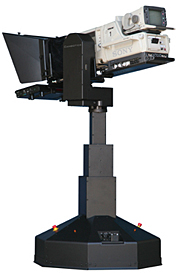

Dolly: When the entire camera is moved forward or backward, this move is called dolly. If the camera is on tripod, the tripod will also be moved. Dollies are often used when recording a subject that moves away or toward the camera, in which case the goal would probably be keeping the subject at the same distance from the camera. For an optimal dolly, the camera should be mounted on a wheeled-platform, such as an actual dolly, or a shopping cart, depending on the budget. Moving the camera forward is called dolly in. Moving the camera backward is called dolly out.
TRACKING: The term tracking shot is widely considered to be synonymous with dolly shot; that is, a shot in which the camera is mounted on a cart which travels along tracks.
ARC: A combination of dolly and truck, the ARC is a semicircular movement or to reveal a view from behind the principle subject.
CRANE: A crane is the movement of the camera atop the long arm of a crane
Camera Shots
Camera Shots
Long Shot (Wide Shot): The subject takes up the full
frame, or at least as much as comfortably possible.
Mid Shot (MS): Shows some part of the subject in more detail while still giving an impression of the whole subject.
Close Up (CU): A certain feature or part of the subject takes up the whole frame.
Medium Close Up (MCU): Halfway between an MS and a CU.
Extreme Close up (ECU): The ECU gets right in and shows extreme detail.
Cut In: Shows some (other) part of the subject in detail.
Cutaway (CA): Usually a shot of something other than the main subject.
Two Shot: A shot of two people, framed similarly to a mid shot.
Over the Shoulder Shot (OSS): Looking from behind a person at the subject.
Point of View shot (POV): Shows a view from the subject's perspective, often looking for empathy from the audience
Weather Shot: The subject is the weather, usually generates a certain mood (if it’s raining - dull mood)
Shot reverse shot, Match on action and the 180 degree rule
Shot Reverse Shot
This is a filming technique used to represent conversation or a connectoin, usually between two characters. It shows character A looking at character B and vise-versa
Match on action
'Match on action' is where shot A is completed or mirrorred by Shot B (the shots come from different angles; looking at the same thing), this in order for the director to show continuity. It may be done to show different perspectaves giving the viewer a quality view of what is happening. It also helps a media text to flow. 'Match on action is demonstrated perfectly in this short passage from 'Friends'
180 degree rule
'The 180 degree rule' enhances/enforces continuity within a media text. This refers to keeping the camera position within a field of 180 degrees of the thing/person being filmed. The line is drawn perpendicular to the camera's viewpoint in the establishing shot of the scene. This rule should especially not be broken in scenes containing sport, a chase and a conversation (etc.)
This is a filming technique used to represent conversation or a connectoin, usually between two characters. It shows character A looking at character B and vise-versa
Match on action
'Match on action' is where shot A is completed or mirrorred by Shot B (the shots come from different angles; looking at the same thing), this in order for the director to show continuity. It may be done to show different perspectaves giving the viewer a quality view of what is happening. It also helps a media text to flow. 'Match on action is demonstrated perfectly in this short passage from 'Friends'
180 degree rule
'The 180 degree rule' enhances/enforces continuity within a media text. This refers to keeping the camera position within a field of 180 degrees of the thing/person being filmed. The line is drawn perpendicular to the camera's viewpoint in the establishing shot of the scene. This rule should especially not be broken in scenes containing sport, a chase and a conversation (etc.)
Subscribe to:
Posts (Atom)